Pauline Ballet
France
Bio
Pauline was born and spent her early years in and around Lyon. She didn’t stay put for long: the family moved wherever her father’s work took them. She was ten and living in Istanbul when her love of images was born. It came naturally, from what lay in front of her — the monuments, the light rising over the Bosphorus. She began capturing it all with disposable cameras, which she went through at a furious rate.
Later, settled in the western suburbs of Paris, she would come into the city often and raid the tourist stalls along the Seine, buying up postcards by the great humanist photographers — Henri Cartier-Bresson, Robert Doisneau, Willy Ronis — who told the story of an earlier Paris. Her bedroom walls were covered with them.
Realising this thirst wasn’t going to fade, her parents gave her a first camera: an Olympus, handed down by an uncle who had rather let it go. She loved the object itself, wanted to learn, and trawled the internet for tutorials on black-and-white photography.
That search led her to a workshop in Uzès — Noir d’Ivoire — run by Yann de Fareins and his wife, also a photographer. Yann had trained at the celebrated École Nationale Supérieure de la Photographie in Arles. They taught the whole craft: shooting, developing film, making prints. To this day, Pauline considers Yann decisive in her career.
She set her sights on the same school, but admission required two years of university first. She found a hybrid degree combining literature and art history, the art side focused on the history of cinema. She loved it, and kept filling her hard drive with images.
Admitted to Arles at last, she sometimes felt out of place — as though she hadn’t quite earned it. Most of her cohort were already deep into their own artistic projects, further along, more assured. She was still looking.
Several internships at Télérama followed, under the wing of picture editor Laurent Abadjian. She was fascinated by the great portraitists who worked for the magazine, though she never took that path herself. What she wanted was to seize the moment.
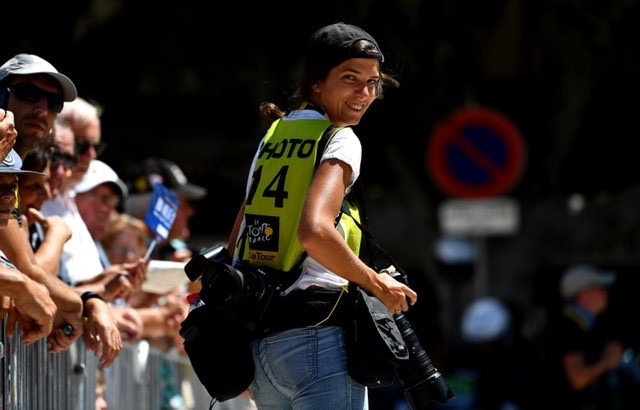
Somewhat adrift as she started her working life, she decided to find a job around photography that would buy her time to think. She joined ASO (Amaury Sport Organisation), working in the archives — sorting, filing and captioning event photographs. Some of what passed before her eyes made her wince. Remembering her training, management asked her to fill in as a photographer on some of the company’s races.
She brought her own way of working, and above all her own way of seeing. The world of cycling caught her instantly.
One of her first assignments took her into the frenzy of the Mur de Huy, the final climb of La Flèche Wallonne and one of the great arenas of the sport. The spectacle is on the road and on the pavements alike. She was won over — and so were her employers: “How do you do that? It’s brilliant.”
They understood at once that their race looked better through Pauline’s eyes. A few months later she was at the start of the Tour de France, shooting for ASO.
For a while she told herself this was something she was doing in the meantime, while she worked out what her real project would be. Then one day it struck her: “Why are you still thinking about your dream? You’re already living it.”
Pauline works freelance today as a sports photographer. The world still fascinates her, and she can’t imagine it ever stopping.
Latest Photographs
-
Les Tauliers
-
Equipier
-
Leo et Paul
-
Mur de Huy (2)
-
Paul Seixas (2)
-
Paul Seixas (1)
-
Mur de Huy
-
Duel
-
Aremberg
-
Le jour de Wout (2)
-
VDP
-
Le jour de Wout
-
Paris-Roubaix (2)
-
Paris-Roubaix (1)
-
5000
-
Rafael Nadal
-
Tournesols(2)
-
Tournesols (1)
-
Le triomphe de Pauline
-
“PFPmania”
-
La Madeleine de Pauline
-
Knesia
-
Marie
-
Lignes
-
Silhouette
-
La piste aux étoiles (3)
-
Trampoline
-
La piste aux étoiles (2)
-
La piste aux étoiles (1)
-
Cyrena
-
Les illusions perdues
-
Cavendish
-
Freestyle